Yoga of Action
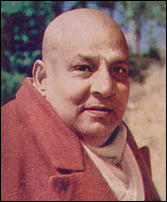
by Sri Swami Sivananda
of The Divine Life Society
What Is Karma?
Karma means not only action, but also the result of an action. The consequence of an action is really not a separate thing. It is a part of the action, and cannot be divided from it. Breathing, thinking, talking, seeing, hearing, eating, etc., are Karmas. Thinking is mental Karma. Karma is the sum total of our acts both in the present life and in the preceding births.Any deed, any thought that causes an effect, is called a Karma. The Law of Karma means the Law of Causation. Wherever there is a cause, there an effect must be produced. A seed is a cause for the tree which is the effect. The tree produces seeds and becomes the cause for the seeds.
How Karma Is Fashioned
Man is threefold in his nature. He consists of Ichha (desire, feeling), Jnana (knowing) and Kriya (willing). These three fashion his Karma. He knows objects like chair, tree, etc. He feels joy and sorrow. He wills to do this, or not to do that.Behind the action, there are desire and thought. A desire for an object arises in the mind. Then you think how to get it. Then you exert to possess it. Desire, thought and action always go together. They are the three threads, as it were, that are twisted into the cord of Karma.
Desire produces Karma. You work and exert to acquire the objects of your desire. Karma produces its fruits as pain or pleasure. You will have to take births after births to reap the fruits of your Karmas. This is the Law of Karma.
The Working Of The Law
As a man sows, so he shall reap. This is the Law of Karma. If you do an evil action, you must suffer for it. If you do a good action, you must get happiness. There is no power on this earth which can stop the actions from yielding their fruits. Every thought, every word, every deed is, as it were, weighed in the scales of eternal, divine Justice. The Law of Karma is inexorable.Things do not happen in this universe by accident or chance in a disorderly manner. They happen in regular succession. They follow one another in a regular order. There is a certain definite connection between what is being done now by you, and what will happen in the future.
Every action produces a threefold effect. It gives you an appropriate reward or fruit. It also affects your character. It leaves behind an impression in your mind. This impression will urge you to repeat the act again. The impression will assume the form of a thought-wave in the mind on account of a stimulus, either external or internal. An action produces an effect in the world also.
If you put a seed in the earth, it sends up a little stem. Then leaves come out of the stem. Then come flowers and fruits. There are seeds again in the fruits. Mango seed only produces mango tree. If you sow rice, you cannot expect a crop of wheat. The same sort of seed produces the same kind of plant. A human being alone is born from the womb of a woman, a horse from a horse and a dog from a dog. Similarly, if you sow the seed of an evil action, you will reap a harvest of pain and suffering. If you sow the seed of a virtuous action, you will reap a harvest of pleasure. This is the Law of Karma.
Whatever you sow by your actions come back to you. If you make others happy through service, charity and kind acts, you sow happiness like a seed; and it will give you the fruit of happiness. If you make others unhappy through harsh words, insult, ill-treatment, cruel acts, oppression, etc., you sow unhappiness like a seed; and it will give you the fruit of pain, suffering, misery and unhappiness. This is the immutable Law of Karma.
Your actions in the past are responsible for your present condition. Your present actions will shape or mould your future. There is nothing chaotic or capricious in this world. You become good by your good actions, and bad by your evil actions.
If you entertain evil thoughts, you must suffer the consequences. You will be in difficulties. You will be surrounded by unfavourable circumstances. Understand the law and live wisely. Entertain noble thoughts. You will be happy always.
The Supremacy of Free-Will
You are the master of your own fate. You are the architect of your own fortune. You are responsible for what you suffer. You are responsible for your present state. If you are happy, it has been your own making. If you are miserable, it has also been your own making. Every action bears a fruit sooner or later. A virtuous action produces pleasure as its effect. An evil deed causes pain.You have no freedom to determine the result of action, but you have freedom to determine the course of action. You can change your character, your thoughts and desires. Man’s will is ever free. Through selfishness his will has become impure. He can render his will pure, strong and dynamic by getting rid of his base desires, and likes and dislikes. Every soul is like a husbandman who has got a plot of land. The acreage, the nature of the soil, the conditions of weather are all predetermined. But the husbandman is quite at liberty to till the earth, manure it and get good crops, or to allow it to remain as a waste land.
What you are now at present is the result of what you thought and did in the past. What you shall be in the future will be the result of what you think and do now. You find an environment which is best suited to the tendencies you acquired in a former life. You can create better conditions for the future. You can make your Karma what you choose. You can rise to a very high state of perfection.
A boatman without oars, rudder and sails is carried away helplessly by the winds and currents; but a clever boatman with oars, sails and rudder, ably directs the boat in any direction he likes and reaches the other shore safely. Even so, he who knows the Laws of Nature—the law of thought, the law of Karma, the law of cause and effect—can sail fearlessly in this ocean of Samsara (cycle of births and deaths) and reach the other shore of fearlessness and immortality quite safely. He will utilise the helping forces to his best advantage and neutralise the opposing forces skilfully, with the help of the knowledge of the Laws. Knowledge is a torch-light. Hence, knowledge is absolutely indispensable. Ignorance is the greatest sin. An ignorant man becomes a victim or a slave of nature.
The Doctrine of Reincarnation
The doctrine of reincarnation or transmigration of souls literally means embodiment again, coming again into a physical body. The individual soul takes again a fleshy covering. The chains that tie you to this wheel of Samsara or round of births and deaths, are your desires. So long as you desire objects of this world, you must come back to this world in order to possess and enjoy them. But, when all your desires for the mundane objects cease, then the chains are broken and you are free. You need not take any more births. You attain Moksha (liberation) or the final emancipation.The Glory of Selfless Work
Selfish Karma leads you to rebirth and rebirth generates new Karma while working off the old. Get rid of Karma if you wish to get rid of the miseries of rebirth. Selfless work will not bind you. It will purify your heart and lead to the descent of the divine light and grace. Understand the Law of Karma (Law of Cause and Effect). Think rightly. Act nobly. Meditate regularly and attain eternal bliss and immortality.A householder’s mind is saturated with many desires. He expects fruits for every action. But gradually he too can wean the mind from expectation of rewards. It is all a question of discipline of the mind. By and by his selfish nature will be destroyed. He will understand the glory of Karma Yoga. Then he will be able to do works without any motives, without expectation of fruits of action. Of course, it is a question of time. One must be patient and persevering.
Two things are indispensably requisite in the practice of Karma Yoga. The Karma Yogi should have non-attachment to the fruits of actions. He will have to dedicate his actions at the altar of God. Non-attachment brings freedom from sorrow and fear. Non-attachment makes a man absolutely bold and fearless. When he dedicates his action at the Lotus Feet of the Lord, he develops devotion to God and approaches Him nearer and nearer. He gradually feels that God works directly through his Indriyas (senses) or instruments. He feels no strain or burden in the discharge of his works now. He is quite at ease. The heavy load which he felt previously on account of false notion has vanished out of sight now.
Karma Yoga prepares the mind for the reception of light or knowledge. It expands the heart and breaks all barriers that stand in the way of unity or oneness.
Ignorant people say that one cannot work without any motive. It is a great pity that they have not understood the essence and truth of Karma Yoga. Their minds are saturated with all sorts of fantastic desires and selfishness, and as a result, their minds are very impure and clouded. They cannot grasp the underlying truth of Karma Yoga. They judge others from their own standpoint. Selflessness is a thing unknown to them. Their minds and brains are rendered callous and so they cannot vibrate properly to understand what a motiveless action is. Passionate householders cannot dream of doing any work without expecting some gain for themselves and their families.
When the thought of doing good becomes part and parcel of a man’s very being, he will not entertain any motive at all. He takes immense delight in serving others, in doing good to others. There is a peculiar joy and Ananda (bliss) in the practice of vigorous Karma Yoga. The Karma Yogi gets inner spiritual strength and power by performing motiveless and selfless actions.
He should understand the secret of Karma Yoga. He should plunge himself in selfless work. He must work incessantly. He must serve society in a variety of ways. Gradually he will understand the glory and splendour of unselfish work. He will become a changed being with divine effulgence and sweet Yogic fragrance. Many of his actions may be selfish in the beginning of his Yogic career. It does not matter. He should not be discouraged on this score. But, slowly when he grows in purity, some of his actions will turn out to be unselfish. In the long run all his actions will be unselfish. He should patiently work with indefatigable energy. He has to destroy his old mind of selfishness and build a new mind of selflessness. This is doubtless uphill work. This demands struggle and constant effort with patience and iron determination. Selfless work elevates and brings freedom. Selfish work retards spiritual progress and fastens one more chain to your feet. If you find it difficult to work without any motive, have one strong motive for freedom when you work. This will not bind you. This will destroy all other lower selfish motives and will eventually die by itself, just as the stick used in burning a dead body burns the dead body and is itself consumed in the end. The joy of a developed Karma Yogi is really unbounded. Words cannot adequately describe his exalted state and inward happiness.
Look at the stupendous and magnanimous work turned out by Lord Buddha, Sri Sankara and other Karma Yogis of yore. Their names are handed down from posterity to posterity. Their names are still remembered. The whole world worships them with reverence. Can you attribute an iota or grain of selfish motive to their actions? They lived for doing service to others. They were examples of absolute self-abnegation.
Expand. Purify your heart. Live in the true spirit of Karma Yoga. Live every second for the realisation of the ideal and goal of life. Then and then alone will you realise the true glory of Karma Yoga. Keep before you the examples of the great Karma Yogis who served mankind and thus radiate peace, bliss and wisdom unto all.