Theory of Concentration
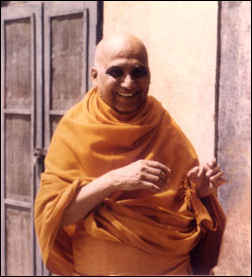
by Sri Swami Krishnananda
of the The Divine Life Society
Usually, the whole of a person can never get concentrated on anything, because of the fact there is practically nothing in the world which can evoke such an interest in the mind of a person. We cannot say that anything in the world is wholly desirable. It may be tentatively desirable, conditionally desirable and partially desirable, but unconditionally desirable objects cannot be seen in this world. The reason why nothing can be unconditionally desirable is because there are things in the world which are other than and different from the objective that is chosen by the mind. It is not possible for you to bring together at one stroke the total objectivity of creation to your attention. You cannot concentrate on the whole world at the same time. As the whole world cannot evoke the attention of the mind, some part of it will be excluded and some other part will draw the attention. That which draws the attention may be considered as valuable and very necessary under certain conditions; but that aspect of reality, that segment of the world which has necessarily been excluded from the point of concentration will set up a subtle reaction. That reaction is called distraction of mind.
The mind wanders here and there and does not permit itself or persuade itself to get concentrated on anything. Since everything is finite, it cannot evoke an infinite attention on the part of any person. Then the attention will also be finite – a finite mind will be thinking of a finite object. Then the result also would be finite and it will be tentative, temporal and evanescent. The excluded part of the world is oftentimes not considered even as existing at all because of a tentative, temporal attraction that the mind feels for one particular object.
Do we know that there are deeper layers of our own mind within us, and they are very powerful media which condition the way of thinking in the waking condition also? There are subtle potentials and vibrations of the psyche in the subliminal level; psychologists call these levels as subconscious, unconsciousness, etc. They actively operate, determining the manner in which the waking mind works, such that the waking mind will be wrongly assuming the role of a self-competent medium of thought, with freedom of choice which it can absolutely exercise. It is necessary to study deep psychology, not for the purpose of becoming a professor of it, but to understand one's own nature. You must know what you are made of. When you think something, you must know why you are thinking in that manner. "I don't know. I happen to think like that." You should not say that. That is an unintelligent reaction to a phenomenon taking place in one's own mind. Every bit of psychological action should understood and should be subjected to careful, rational study. One cannot afford to be unintelligent about one's own self – that will serve no purpose.